


A plantar wart is a benign growth on the foot or toes.Plantar warts are found in about 34% of non-cancerous skin growths.Dermatology deals with the diagnosis and subsequent treatment of such neoplasms.When trying to treat a wart, it is highly undesirable to use traditional methods and try to get rid of it with your own hands, because a plantar wart has a root that goes deep into the skin, and its incomplete removal can lead to secondary growth of the wart, or, on the contrary, seriously damaged surrounding tissues can cause the appearance of neoplasms in other parts of the body.
Causes of plantar warts
Condylomas, papillomas and other types of warts (plantar, common, filiform, flat) are caused by human papilloma virus (HPV) infection.HPV is transmitted between people through contact (via infected cells).The most favorable environment for the transmission of the virus will be a warm and humid environment.Therefore, people often get infected with HPV in baths, saunas, swimming pools and gyms.If the immunity of the body is strong enough, HPV can remain hidden and does not cause any clinical manifestations.The failure of the immune system activates the virus, and the above formations begin to appear on the skin.
The appearance and development of plantar warts is facilitated by factors such as excessive drying or sweating of the skin of the feet (hyperhidrosis);uncomfortable, tight and rubbing shoes;various foot deformities (deforming osteoarthritis, arthritis of the joints, flat feet);diseases that disturb the trophism of the foot tissue (atherosclerosis, varicose veins of the lower extremities, diabetes mellitus, etc.), damage to the surface of the foot.
Manifestations of plantar warts
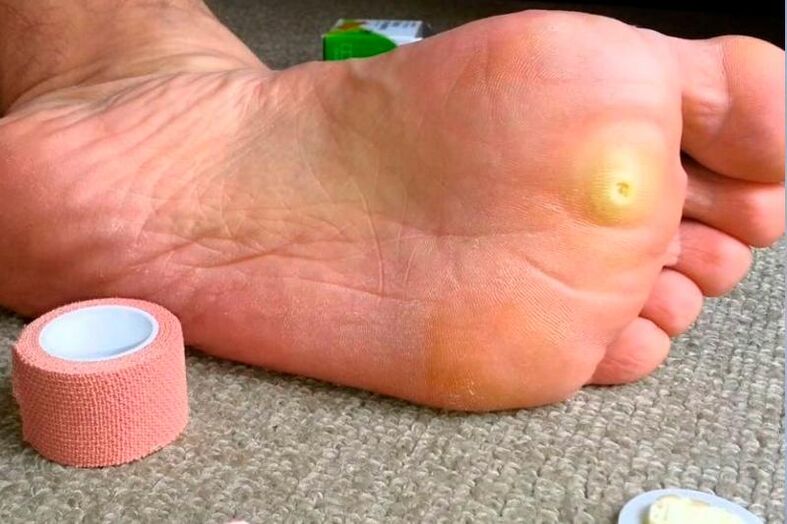
Most often, a plantar wart is round or oval in shape with a diameter of about 1-2 cm and protrudes 1-3 mm above the skin.The skin color of a plantar wart usually stays the same, but sometimes it can be pink or light brown.
At first, the surface of the wart is smooth, but later the neoplasm is covered with layers of keratinized epidermis, the surface becomes rough and changes its color to gray-yellow.In the center, on the surface of the plantar wart, crater-like depressions are sometimes noted.Black-brown dots, which can often be observed on the surface of the wart, are caused by thrombosis of surface capillaries.
Plantar warts are usually solitary in nature.The formation of similar warts may indicate that the virus has reached high activity.Many warts show a mosaic pattern on the affected area of the skin, which is why they are called "mosaic warts".
Plantar warts may disappear on their own.In such conditions, they disappear without a trace on the skin of the foot.However, because warts are often scarred, they rarely disappear on their own.Even if the tumor itself does not cause pain, it can still cause significant discomfort to the patient and often sharp pain caused by pressure or friction under the wart.
Diagnosis of plantar wart
A plantar wart often looks like a thickened stratum corneum (hyperkeratosis) or callus.Only a highly qualified dermatologist can distinguish warts from callus and hyperkeratosis.For this, the doctor conducts dermatoscopy.To better examine the form, the dermatologist first scrapes off the top layer of keratinized skin.A skin pattern that is not on the surface of the formation and the identified symptoms of petechiae ("clogged capillaries") speak in favor of a neoplasm.Positive results of HPV and PCR diagnostics confirm that the patient is infected.
In order to determine the depth of the root of the germinating plantar wart, the patient is prescribed an ultrasound of the skin formations.However, if there is a doubt that the wart is malignant, the patient should consult a dermato-oncologist.If a disease or deformity of the foot is detected, it is necessary to consult a podiatrist.
Plantar warts are considered separate from keratoderma of the palms and soles in Reiter's syndrome.The smaller size and shape (flat, not conical) of formations, petechiae, or the so-called "thrombus capillaries" symptom, as well as the absence of inflammatory changes around the keratinized layers of the epidermis, allow distinguishing plantar warts and keratoderma.
Plantar warts also share some common features with palmoplantar syphilides.Syphilides are multiple in nature, have a characteristic ring or arch structure, are painless and have a positive RPR test for syphilis.
Treatment of plantar warts
Plantar wart removal is complicated because, unlike other types of tumors, it grows deep in the dermis.For example, for this reason, electrocoagulation is not always suitable for removing warts.The use of electrocoagulation is possible only if the plantar wart is not deeply located.In this case, electrocoagulation will provide healing without a trace.
Cryodestruction of a wart gives positive results that directly depend on the specialist's qualifications, because too deep an impact on the tumor can cause scars, while too superficial an impact can cause the wart to reappear.After treatment with liquid nitrogen at the site of a wart, the blister that appears should not be damaged until it heals (healing takes about a week).
Laser removal gives the best cosmetic result, as this method allows you to adjust the depth of exposure.Laser wart removal is painless and quick, and healing takes about a few days.
The radio wave method, in which the tumor is cut with a radio knife, can also be used to remove plantar warts.At the same time, cauterization of vessels occurs, which prevents the virus from entering the blood from the neoplasm.
Surgical removal is suitable for large plantar warts.The procedure is performed using an ordinary scalpel and local anesthesia.There is a possibility of complications - this is the appearance of a scar.
Prevention of plantar warts
The primary prevention of plantar warts is to prevent HPV infection.It is worth paying special attention to mandatory wearing of personal shoes in places such as showers, swimming pools and baths.For people suffering from foot diseases, an important role in preventing the formation of plantar warts is proper and regular care of the skin of the feet: peeling and treating the feet with emollients, as well as regular pedicures.
Patients suffering from foot deformities should use orthoses, release sectors and orthopedic insoles.If your feet sweat a lot, you should use deodorants and drying agents and choose shoes made of natural materials.If the skin of the feet is very dry and has cracks, then it is necessary to use creams that can nourish and moisturize the skin of the feet.You should also regularly take medicated foot baths.
Secondary prevention of the occurrence of plantar warts is to prescribe antiviral drugs and immunocorrectors to the patient in addition to wart removal.